

Spaceship 47 is the board game of the best 90s Sci-fi TV show that never existed. It is a co-operative campaign game for two to five players, where each player will take control of a single character and work together as a team to complete the missions. This is the second in a three-post series discussing where the game is at the moment. The first post can be found here.
Barriers and Hindrances
It would be a pretty boring game if there was nothing for the players to fight against, nothing for them to overcome. Therefore, we need to add barriers to progress and hindrances for them to overcome while they are trying to rescue Earth from the iron grip of the evil Draydun aliens.
Currently I can see three distinct types of hindrances to the payer characters:
- Enemies – sentient beings, robots, creatures, etc.
- Obstacles – Locked doors, chasms to big to jump across – anything that is an inanimate object that by existing, makes it harder for the players to complete their mission.
- Conditions – When players get hit by attacks, when obstacles get too much for them, they might have conditions imposed on them, such as being DAZED, RESTRAINED etc.
Let’s use the example of the very first scene that the players will encounter to show how the game (as it currently stands) will handle these elements.
The first episode/mission starts off with the Heroes (characters played by the players) escorting a prisoner to a ship. The prisoner has been found guilty of killing the Stishak Ambassador to Earth.
Also on the scene are a protest group who believe that aliens should not be allowed on earth and who support the killing of the ambassador, and will attack the Heroes, hoping to release the prisoner. A counter-protest is also taking place that will try and attack the protestors and some of the more extreme elements of the counter-protest will even try and kill the prisoner.
The Mission Objective is to escort the Prisoner to the ship without him or any other human dying.
Enemies
My motivation for enemies in the game is that I want the actions that the enemies take to feel logical. I’ve played some games that just randomise the enemy actions and it leads to them acting in odd ways.
At the same time, I want the resolution of what action and how successful it is to be quick. The game should be focused on the players and their decisions and shouldn’t take the spotlight away from them for too long. This is what I’ve come up with. I doubt it will survive play testing, but I am looking forward to seeing how it plays out.
As an example of the thought process, lets take the Protestors from the first scene. They want to get to the Prisoner to free him.
Action 1: Move up to 2 spaces towards the Prisoner
The Protestors will want to attack the Heroes when they are in range so that they can free the Prisoner
Action 2 : Throw a Smoke Bomb at a Hero
If the Protestor is getting attacked by the counter protestors, they will want to react by attacking them back.
Action 3: Throw debris at a Counter Protestor
And finally, if they have been injured enough then they will retreat.
Action 4: Move towards the corner of the map
There will be four protestors in this scene, who will all have these four actions available to them. Therefore we can create a single card for the four protestors which you can see below.

This card contains:
- the name of the enemy (Protestor);
- the trackers to use for the four enemies (A, B, C and D);
- the defence values for the Protestors (Dodge = 2, Fortitude = 3 and Will = 1);
- The four actions that were listed above.
- Grey square – Move towards Prisoner
- Green cube – Attack a Counter Protestor
- Magenta Cube – Attack a Hero
- Red Disc – Retreat
We now have the four actions the enemy can take, but when it is the enemy’s turn, how do we let the players know which action the enemy should take? Through the use of cards, a board and coloured cubes/discs.
Below is the enemy tracker board used in all missions. There are eight columns, one for each potential enemy in a scene (not all columns are used in every scene). As denoted by the Protestor card above, columns A through D are to be used for the Protestor enemies.
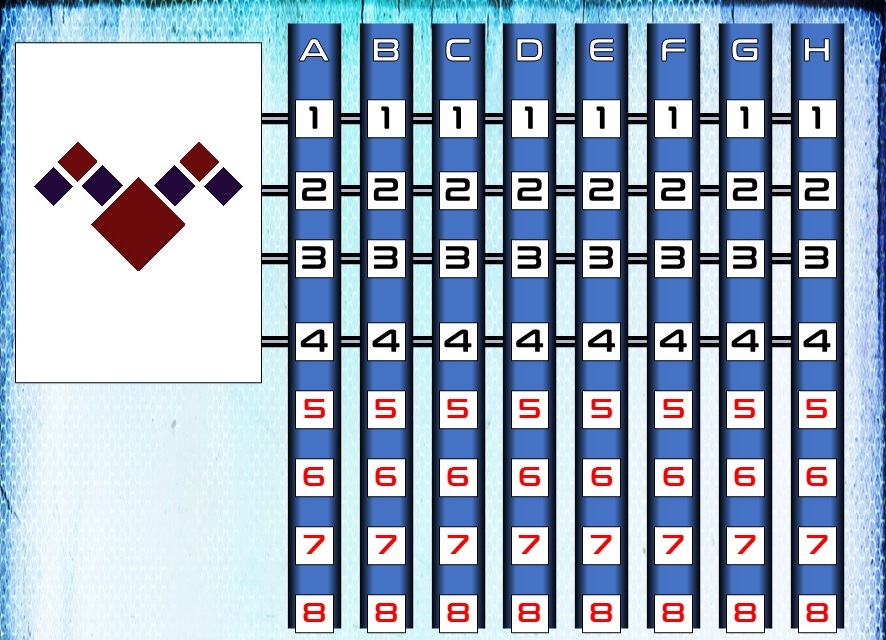
The numbered squares serve two purposes. The first is to track the health of the enemy. The maximum amount of health these enemies can have is eight. When an enemy takes damage, a number of red discs equal to the damage taken is added to the highest numbers that are not covered by a red disc. Once all eight numbers for a particular enemy have been covered by red discs, that enemy is dead.
The lower four numbers – the ones with horizontal lines going through them – are used to determine the action an enemy takes. Throughout the scene, the players will be instructed to add cubes to these numbers. Usually this is because they have successfully attacked the enemy, but other times it might be because the enemy has wandered into a certain section or other mission dependent triggers. After a few turns the board should look like something like this.
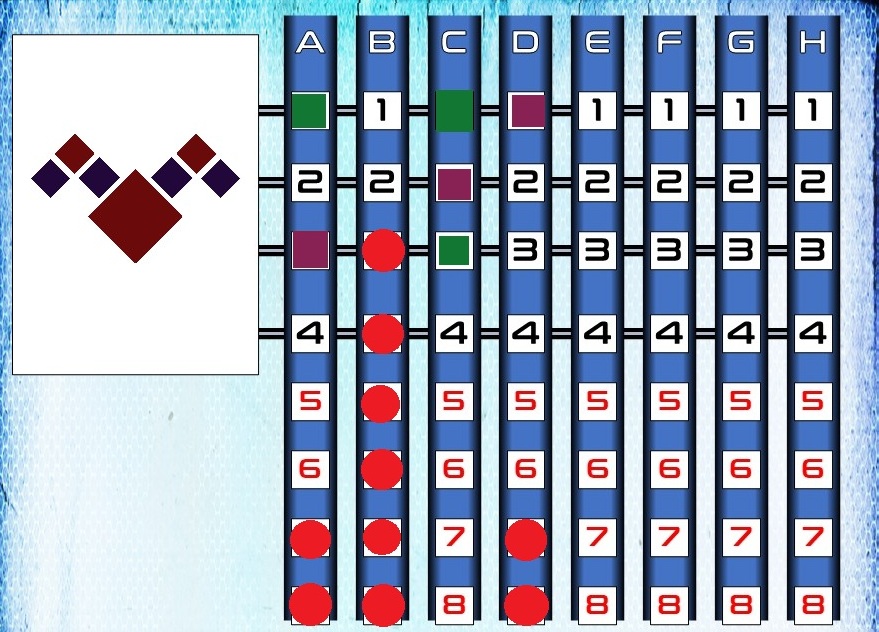
Here, enemy B has been injured the most as it it only has 2 health left. While enemy C has not been injured at all. Each of the enemies has various numbers of cubes and discs on their tracker, so how do we decide which of the actions triggered by the different coloured cubes/discs will occur? A deck of Enemy Action Resolution Cards is used. An example card can be can be seen below.
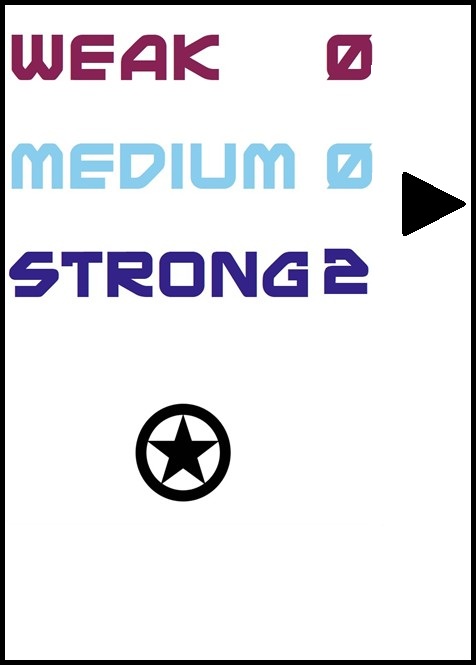
There are five elements to this card, the WEAK, MEDIUM and STRONG values, the arrow on the right of the card and the star in a circle. The arrow is what decides which action the enemies take. When a card is drawn it is put on the board like below.
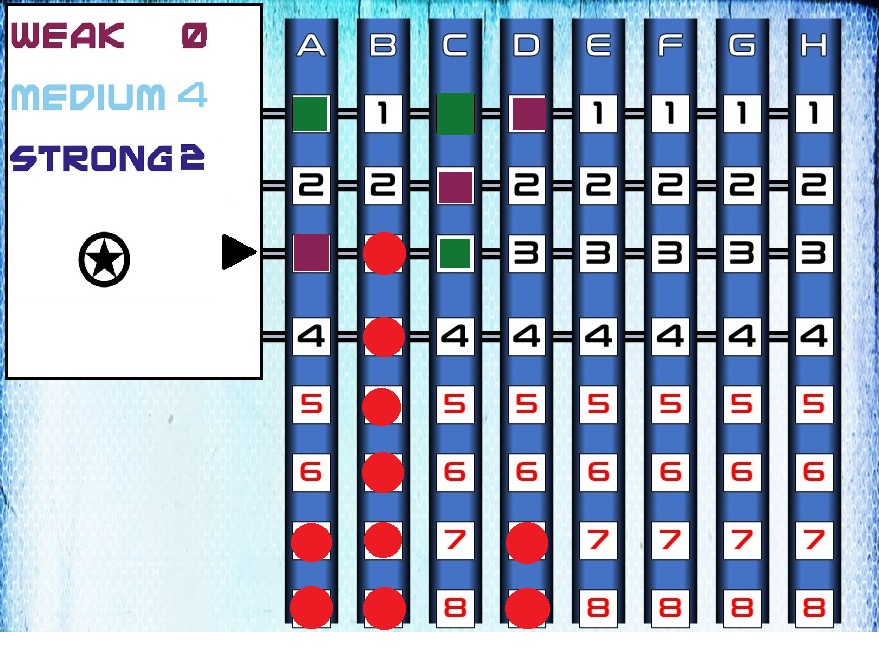
The arrow on the card is pointing at the third row. Because Enemy A has a magenta cube on their third slot, they will take the Throw Smoke Bomb action. Enemy B is too hurt to fight as it has a red disc on its third slot and so will take the Retreat action. Enemy C will take the Throw Debris action as the counter-protestors must have attacked them. Finally, Enemy D will take the default action which is to get closer to the Prisoner.
The strength of any attacks made by an enemy is determined by the WEAK, MEDIUM and STRONG values on the Enemy Action Resolution card. The example Protestor card says that the Throw Smoke Bomb attack is MEDIUM v Dodge. In the example Enemy Action Resolution card on the board, the MEDIUM value is 4, so therefore, to determine whether the attack hits, you would compare 4 to the value of the target’s Dodge value, if it is higher than the Dodge value, then it succeeds. All enemy attack values are even, and all Hero defence values are odd, so there will never be a tie when an enemy attacks a Hero.
I feel like the actual time taken to resolve the enemies’ actions on their turn should be fairly quick. Draw a card, go from left to right to see what each enemy does, resolve the action with the help of the WEAK, MEDIUM and STRONG values printed on the card and voila, back to the Heroes. The major flaw I am anticipating is it being fiddly putting cubes on the enemy tracker board when it isn’t their turn.
Obstacles
Like most co-operative board games, Spaceship 47 will require the players to have to handle different problems at once, deciding what resources they need to assign to each problem so that they can succeed in their mission. Enemies are one type of problem and Obstacles are another type.
As obstacles will be non-sentient stationary things, the mechanism for interacting with them will be a lot simpler than for enemies. The exact mechanism will be dependent on what mechanism I use for the players to select the Hero actions. At the moment I am thinking that obstacles will either be overcome by a single successful action in which the players spend resources to accomplish the task, or by multiple successful actions, requiring the players to focus on overcoming the obstacles while other things are vying for their attention.
To make the Heroes feel more fleshed out, I want them to be good at different things. This then means that Obstacles need to have multiple ways to be overcome, as a game with 2 players will not have as a wide spread of skills as if there were 4 Heroes. A Scientist or Engineer might fix the keypad, whereas a Soldier might just try and kick the door in. The obstacle will list the different skills that can be used to overcome it, so that the players can decide what party resources they will spend on this particular problem out of the many that they are facing.
Conditions
Throughout the the game, various obstacles, enemies and even the map itself will impose negative conditions on the Heroes. Some of the most common ones you see in this type of game are:
- Prone – The Hero is prone on the floor, it is easier to hit
- Slowed – The Hero can no longer move up to their maximum speed
- Restrained – The Hero cannot move at all and it is harder for them to attack
- Blinded – the Hero cannot see, it is harder for them to carry out tasks
- Weakened – the Hero is suffering some sort of poison or venom and is feeling sluggish, the Hero is easier to hit.
- Dazed – The Hero has been hit pretty hard and will stagger around for a bit
Again, I need to know exactly how the players are going to select their actions before I decide how to implement these conditions that would impede the action selection. If, for example, the mechanism was deck building and the player has a hand of cards to choose from for their Hero’s action and the Hero gets Blinded, then maybe the player would have to discard a certain number of cards to be able to play an attack card. Hands of cards can be used in other ways such as changing the hand limit, having cards that the player has to play during their turn etc.
Conclusion
Blimey, that was quite a slog of a post to write, but it has helped me refine my thoughts on some things so it was useful. Next up? Work out exactly how the player chooses their actions.
 Spaceship 47
Leave a comment