

So far I have talked about what the board game is going to be played on, and the mechanisms of who the game is being played against. Now it is time to talk about how the players play the game.
Each player will take control of a single character from the fake 90s Sci-fi TV show called Spaceship 47. On their turn, players will decide what their character does, and after all of the players have acted, the enemies take their turns (using the system I outlined in the previous post).
Player Board
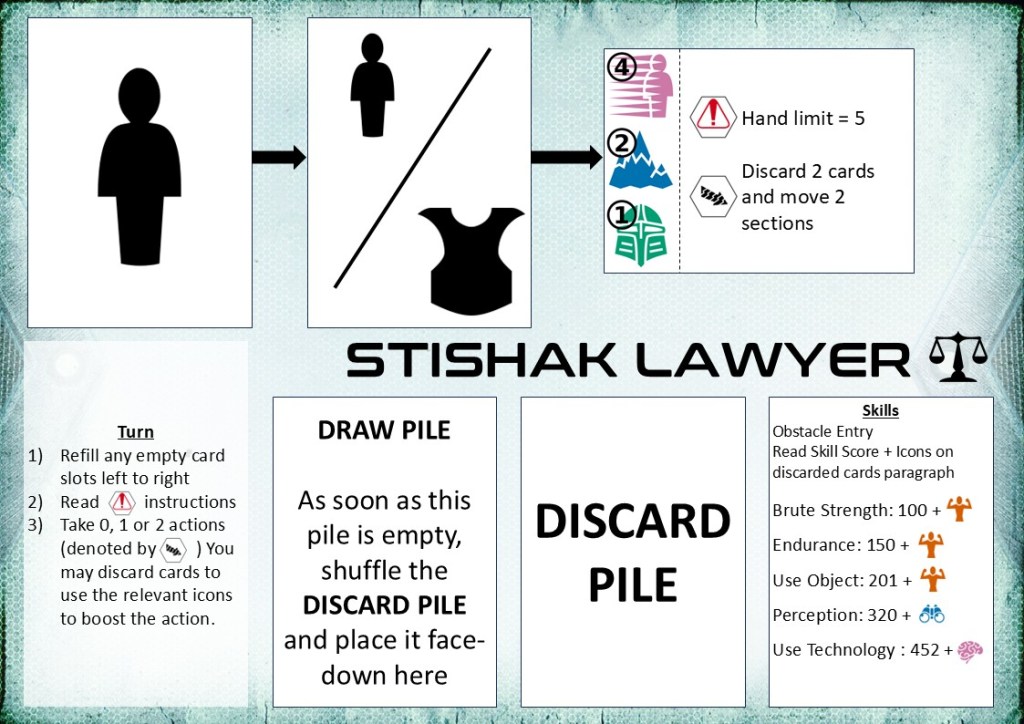
Let’s start with the player board. Each player will have one which serves multiple functions. An example for the Stishak Lawyer character is shown below.
Top Half of the Board
The top half of the board deals with a player character’s defences and movement.
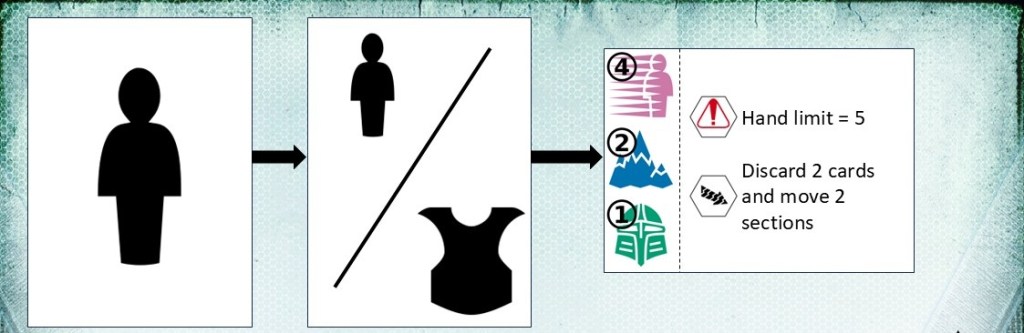
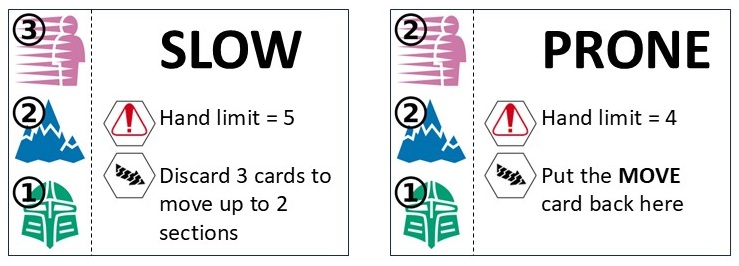
Two slots are available for the player to put NPCs in. Some missions will require the Heroes to accompany/rescue/kidnap NPCs. One of these slots can instead be used for a piece of armour that a player may pick up throughout the campaign. The arrows show that attacks come in from the left, and will hit the NPC first. If there is no NPC in that first slot, the attack will then move onto the second slot and hit the NPC or Armour in that slot. Finally, if it gets through all of that it hits the character with the defences of the character shown in the final box. This box also serves as the state of the character in terms of movement/Slow/Prone. The above example has the character’s normal movement card in it showing that if they want to move 2 sections, then they need to discard two cards from their hand. If the character ever gets hit with the SLOW condition the card is flipped over to the reverse side where the defence values have changed and the number of cards needed to to be discarded to move has increased (below left). Finally if the character has been knocked Prone, then the card is taken out of the board, revealing the Prone condition that has been written on the board itself (below right).
Bottom Half of the Board
Going back to the Player Board, the bottom half is all about the payer’s turn.
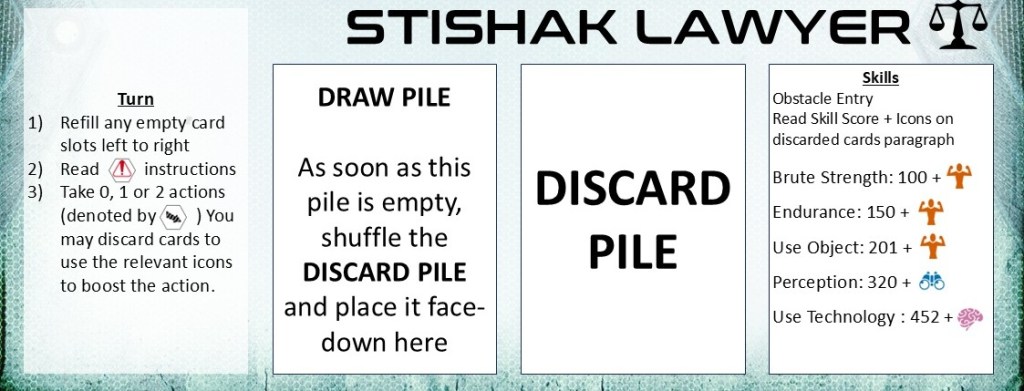
The text in the left most box tells the player what they can do on their turn, the middle two boxes has the player’s deck and discard pile. Finally the box on the right contains the skill list for the character. I haven’t decided whether the list will be exactly the same for each character or whether each character will have slightly different skill lists.
Player Actions
The characters need to be capable of overcoming all of the challenges that they face. For example, if there is a brick wall and no character has a way to get to the other side then that is stupid. However, the players should be limited in what they can do on a turn or the game would be too easy.
Deck Building
I’ve chosen deck building as the mechanism with which players decide what to do on their turn. A player’s deck will have the potential to contain all of the abilities they need to complete a mission but the deck may not contain the abilities at the start of the game. As the episode continues, then like characters in a TV show, the characters will learn more about their situation and be able to overcome the challenges faced. This is represented by gaining better cards throughout the mission just like any good deck builder.
Deck Builders were all the rage a few years ago when I was really getting into making this game, and as I hate jumping on band wagons, I resisted for far too long to use this mechanism for Spaceship 47 (and I love Deck Building games!). But the starting out with limited abilities and growing over the game, matches the format of the type of TV show that Spaceship 47 would’ve been too well for me to not use it.
An example card can be seen below. The arrow in the circle in the top left of the card denotes that it takes one of the player’s actions to play the card. The text next to the arrow is the name of the action, in this case it is “Sniper Rifle”.
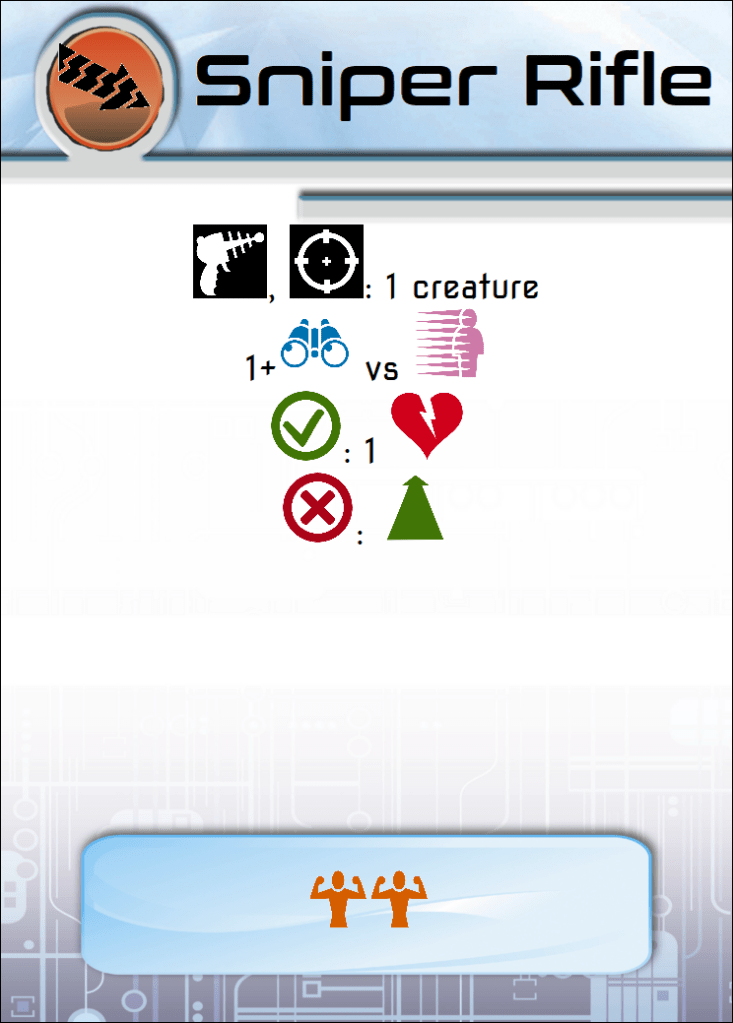
Below that is a ray gun which denotes that the action is a arranged attack. Ranged attacks mean that the player can target any other location card that shares a targeting colour with the location card they are standing on (see this post for more details). Next to the ray gun symbol is the target symbol and the text “1 creature”, which further defines who the player can targe with this action.
The next line has “1 + Vision icon vs dodge icon”. This means that the attack score for this action is 1 plus however many Vision icons are on he bottoms of cards that the player will discard to boost this attack. That total is compared to the target’s defence score. If the player’s attack score is higher than the target’s defence score then the action succeeds, otherwise the attack fails.
Below the attack line is a green tick in a green circle. this is the line which tells the player what happens if this attack succeeds. In this case the 1 broken heart means that the player has inflicted one damage on its target.
Below the success line is the failure line, which is denoted by a purple cross inside a purple circle. In this case the green up arrow denotes that the player can take one level up card from the level up deck and put it to one side. If a player ever gets three level up cards, then they can look at them, pick one to add to their player deck and discard the other two level up cards.
The final part of the card is at the bottom, where two icons of the strong man pose (which denotes Physique in this game). This means that instead of using this card for its action, that it an be discarded to add two physique icons to another action that the player is using.
Skill Usage
During a mission, certain locations will have things that the players can interact with – locked doors, impassable chasms, etc. These locations require skills to overcome. The player will choose which skill that they wish to use from their player board, then they can discard cards from their hand with the relevant icon on them, to boost their skill check. The skill list from the example player board above is repeated below. The player has the option of using one of five skills:
- Brute Strength: 100 + Physique
- Endurance: 150 + Physique
- Use Object: 201 + Physique
- Perception: 320 + Vision
- Use Technology: 452 + Intelligence
Each of these skills has a number next to them with the + symbol and then one of three icons. This means that when the player selects that skill, they take the base number and adds the number of relevant icons on the boost section of cards that they have discarded to boost their skill check. Then the player opens up the mission book to the appropriate location entry and reads the numbered paragraph that relates to their skill check result. The text will tell them what happens next. this was inspired by the Adventure Games by KOSMOS.
Character Arcs
One of the things that I wanted to do for this game is to make it feel like the character that the player is playing, goes through a character arc over the course of the campaign. Looking at shows like Babylon 5 and Deep Space 9, it would be impossible for this board game of a 90s Sci-fi TV show to not have the characters evolving. An advantage of having this continuous personal story that the players are playing through, is that some campaign board games tend to fizzle out before they are finished. I am hoping that in addition to the relatively low number of missions (twelve), that players will be eager to see how their character arc ends.
Lots of board games these days, have emergent stories, almost being like RPGs in that respect where the story is not pre-determined and the narratives emerge naturally from the interaction of player decisions and the components of the game.
Unfortunately, I am not smart enough to design something like that, so I am going to create a specific character arc for each character in the game. The arc will have the character starting out in one position, for example hating Humans, and then evolve into another position, for example, accepting that Humans are OK. To me this is more like a traditional board game where you are given a specific goal and try to achieve it as best as you can.
For a player to win Spaceship 47, they and their team mates need to have succeeded in the overall campaign in addition to the player completing their character’s story arc.
The beats of the story arc will be in the form of player action cards. The first stage of one of the character arcs is shown below:
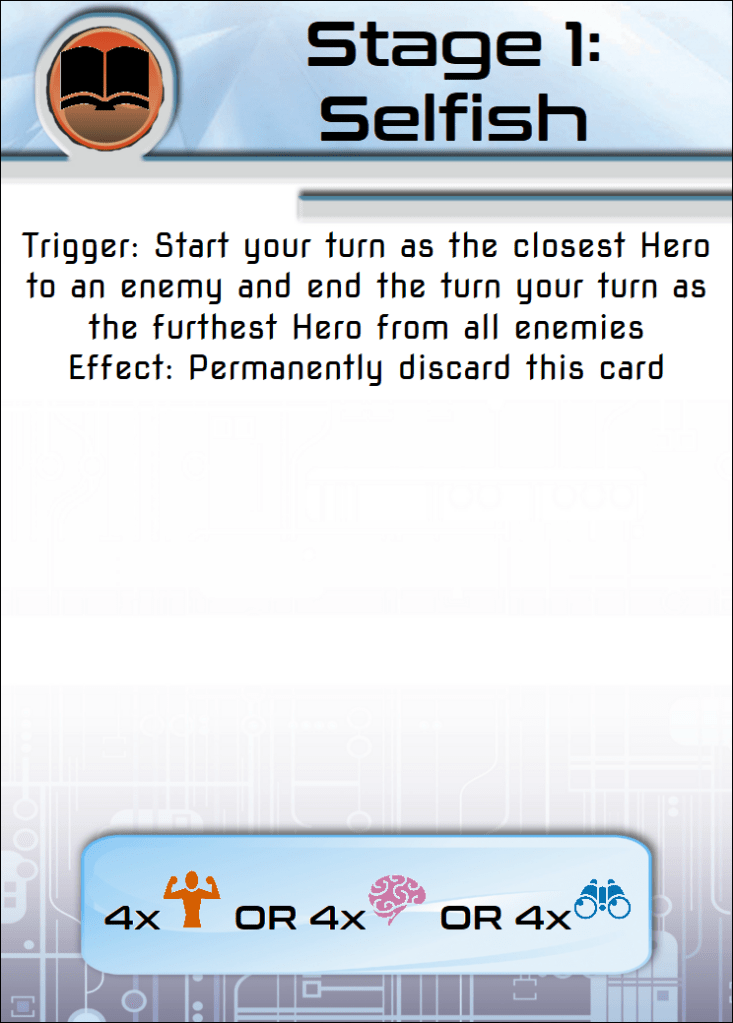
The open book icon in the top left shows that this card is a character arc card. The text to the right of this is the title of the card, in this case Stage 1: Selfish. The main text tells the player what they need to do to achieve the goal of this stage of the character arc, in this case, start their turn as the closest Hero to an enemy, but end their turn furthest away from all enemies.
The Effect line is next and tells them what to do if they achieve this goal, namely to discard this card permanently.
Finally in the boost section, this card can be discarded to boost other actions, but it contributes 4 of any one icon. to the check This is better than any other card that the player starts off with.
This card is incredibly useful in the deck of a player, so the player has to decide whether they want o rid themselves of the card, or whether they want to complete the stage of the character arc. Only one stage of the story arc can be completed per mission.
Conclusion
This post has taken me ages to write. Mainly because I’ve entered another game I am working on into a competition, so my focus was on that. But also, I’ve been going round in circles with this topic with various different ideas, until I realised I just need to put something down (i.e. what I already had decided before brand new ideas kept entering my head) and play test it and if that doesn’t work then change it. So there we are, the third post that should give people an idea of what this game is. Now on to designing the first mission. Wish me luck!
 Spaceship 47
Leave a comment