

Spaceship 47 is the board game of the best 90s Sci-fi TV show that never existed. It is a co-operative campaign game for two to five players, where each player will take control of a single character and work together as a team to complete the missions. This is the first in a three-post series discussing where the game is at the moment.
Game Overview
The game will be the first season of a non-existent 90s Sci-fi TV show, which is twelve episodes (or missions) long. I am aiming for each episode to take about 2 real-world hours to complete.
Each player takes control of a single character to navigate the mission that the players are playing through. The idea is that each player plays their character for the entire season, attempting to complete the over arcing character’s story, as well as contributing to the success of the individual missions with the other players.
Each episode consists of three scenes, with the players playing through each scene in turn, completing the scene objective before moving on to the next scene. The three scenes, along with the read aloud text between scenes makes the five act structure of a TV episode.
The Map
The must-have requirements for the map in this game are:
- Fast setup – I don’t want a bunch of tiles that you have to put together based on a map in a book
- Dynamic – I want the map to change as a result of player decisions or story beats that throw up new obstacles for the players
- Easy line-of-sight – I would like the players to be able to look at the map and know exactly which characters can see which other ones on the map. No rulers, no counting.
The nice-to have but not essential requirement is:
- 90s TV Show Budget – I would like to give the impression that the same set is being redressed for “new” locations due to the budgetary constraints of a 90s TV show
I have come up with an idea that meets all of the above requirements, but unfortunately I don’t think its is feasible.
Current Idea
The game will come with two boards, one for scenes that take place outside and the other board is for scenes that take place inside. The board for the outdoors scenes is shown below. The boards will be dual-layered and each white rectangle is a recess, the size of a playing card.
For each scene in a mission, the players deal cards into the slots of the board to make up the map for the scene. This matches requirement (1) as the setup is as fast as dealing cards out and putting some enemy standees on certain cards. It also meets the non-essential requirement as there will only be two boards being redressed each mission. The board used for outdoor scenes is shown below. On the left, the cards have not been dealt out and on the right the cards have been put in their appropriate slots.
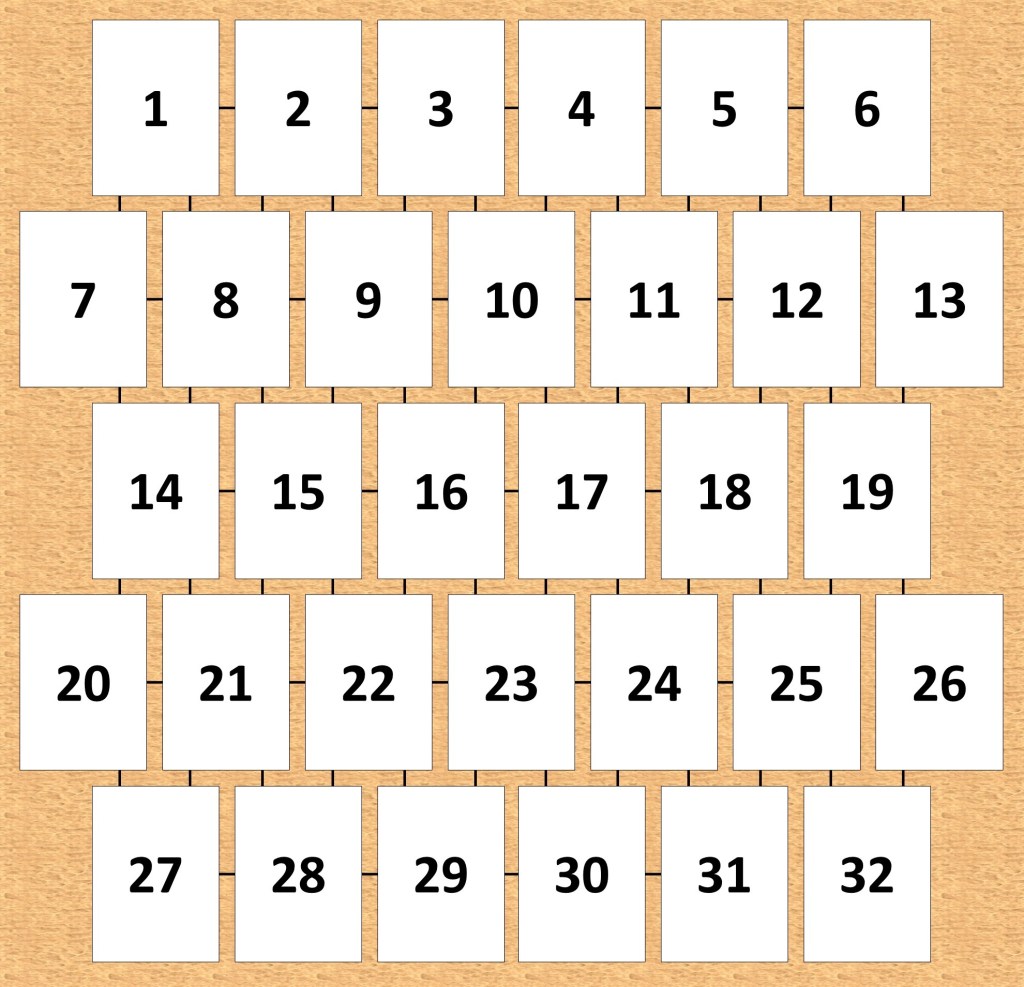
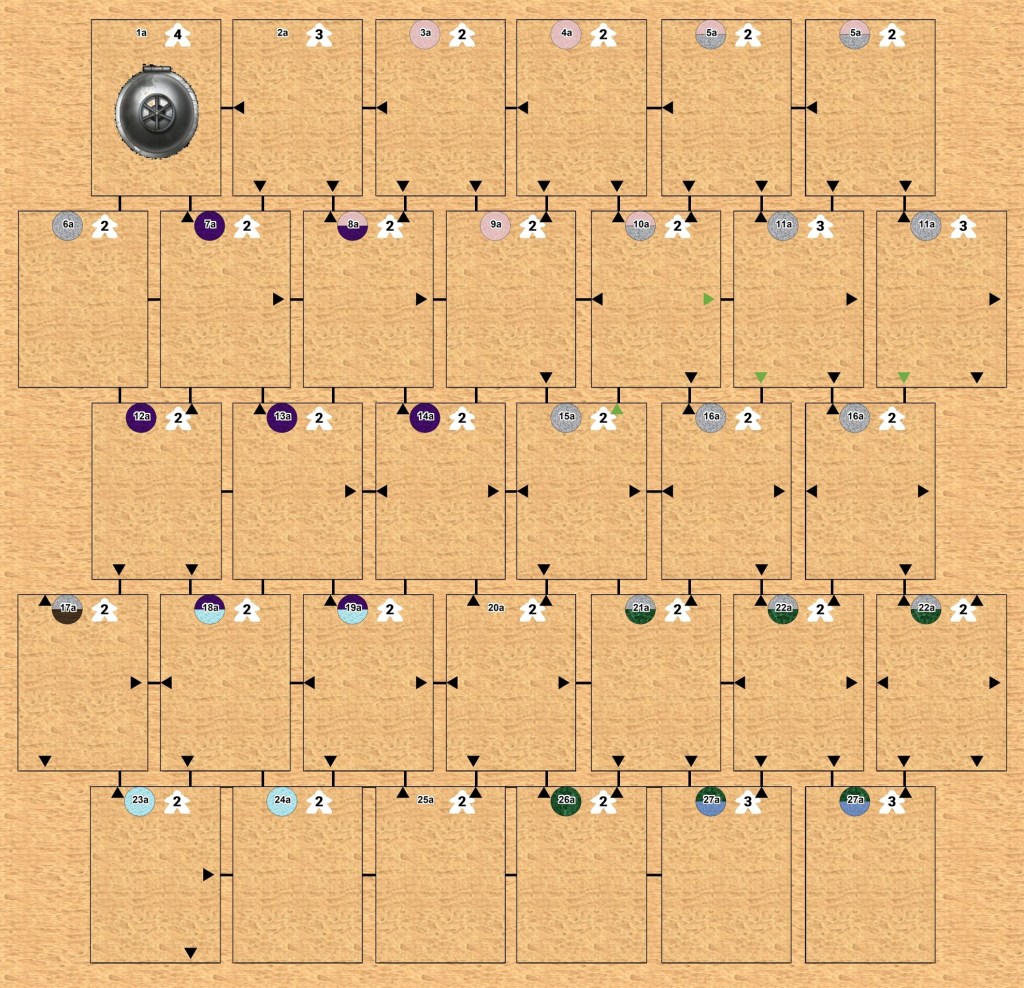
The board for scenes that take place outside
Below is an example of one of the location cards.

An example of a location card
The location card has the following elements, which most location cards in the game will have:
(a) A circle with a number in it. The number is which slot the card goes in. The colours in the circle make the targeting of ranged attacks simpler. It uses the Tannhauser mechanism reimplemented by Unmatched. If the card your character is on and the card your target is on have a colour in common in the targeting circle then you can attack the target with a ranged attack. This meets requirement (3)
(b) A meeple with a number on it. This shows how many characters (both player characters and non-player characters) are allowed on the card;
(c) Arrows showing which direction a character can move. At times, the arrows will be different colours to help with the game. For instance, the green arrows in the complete map above dictate the direction a player character is forced to move while they are suffering from the DAZED condition in this particular mission. Other coloured arrows could be used to show which way guard robots move as they travel round their preprogrammed route.
(d) Other images, such as the hatch in the example. The reverse side of the card shows the hatch open; This meets requirement (2) as flipping over the cards changes the state of the map, making it dynamic.
(e) An image as the background that helps make up the map, not leaving any blank spaces on the board.
So, if this map system meets all of the requirements, what is the problem? The sheer amount of cards I will need! I am going to make 12 missions, each with three scenes in. The indoor map is arranged differently to the outdoor board and holds 35 cards. If I need an average of 33 unique cards for each scene, then that is a total of 1,188 cards over the entire campaign! And that is just for the maps, that does not include the cards for player actions, equipment, NPCs and who knows what else I will need.
To put this in context Gloomhaven has a total of 727 normal sized cards and 975 mini sized cards. Vantage, a game where you explore an entire planet only has 1,300 cards. Vantage doesn’t have two big boards to fit into its box either.
I think over 1,188 cards for the game is unfeasible, especially as I need room in the box for the two boards, the player boards, minis for the player’s characters, etc. Therefore, I either need to come up with a completely new way to do the maps, or modify this system so that it uses fewer cards.
My first thought was keeping the board as is, i.e. having recesses for cards to be put in but instead of the recesses being blank, there are default “cards” printed into each recess. Then, for each scene, cards are put into just the slots where they are needed for that scene. If I were to limit the map to using 5 cards per scene that would reduce the number of map cards needed for the entire campaign to 180.
Then I remembered the line of sight mechanism. If I put a card in slot 3, then the line of sight for cards 2, 4, 9 and 10 will almost certainly need to be changed. Already the number of cards is creeping back up to the numbers I didn’t like.
So the line-of-sight rule would need to be changed. I could just make it that melee attacks target anything on the same location as you and ranged attacks can target any connected location, but this seems overly restrictive.
This really feels like something I will only resolve as I actually create the missions, so I better get on with that!
Conclusion
With the number of cards needed for the current map seemingly excessive and with a change to the maps potentially killing the line of sight rule, it really feels like a “killing your darlings” moment. The trouble is I don’t know which darling should be killed and what would replace it.


Leave a Reply